

Quick answer: For most CrossFit-style training, our best overall pick is the Gymreapers 18-inch Wrist Wrap. It provides meaningful support for presses and Olympic lifts without using the extra-long, very stiff construction favored by powerlifters. Choose a flexible cloth wrap when fast adjustment and wrist movement matter more; choose a longer elastic wrap when maximum support matters more than mobility.
Wrist wraps are not all built for the same job. A wrap that feels excellent during a heavy bench press can be annoying during cleans, thrusters, handstand work, and fast transitions. The best choice is the least restrictive wrap that gives you enough support for the movements you actually train.
Best wrist wraps for CrossFit at a glance
Best overall: Gymreapers 18-inch Wrist Wraps
Best for: Athletes who want conventional elastic support for presses, jerks, overhead squats, and strength work.
Why this pick: The 18-inch length sits in the useful middle ground: more support than a flexible cloth wrap, with less bulk and winding than extra-long powerlifting wraps.
Skip them if: You dislike thumb loops or want a wrap you can loosen instantly between movements.
Best flexible option: Velites Nylon Wrist Wraps
Best for: Longer WODs, Olympic lifts, gymnastics transitions, and athletes who value mobility and quick adjustment.
Why this pick: The flexible fabric design is easier to fine-tune than a stiff elastic wrap. Tighten it before an overhead set, then relax it without fully removing it.
Skip them if: Your priority is the firmest possible support for heavy benching or low-rep pressing.
Which wrist-wrap style should you buy?
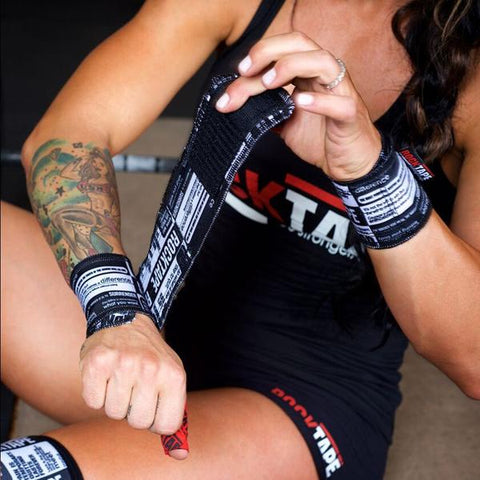
Flexible cloth wraps: best for WODs and fast transitions
Cloth or flexible-fabric wraps trade some rigidity for comfort, movement, and quick adjustment. They make sense when a workout mixes movements and you do not want to remove your wraps every round. They are also the safer starting point when you want a small amount of support without making the wrist feel locked in place.
Elastic wraps: best for pressing and heavier support
Elastic wraps use tension and overlapping layers to create firmer support. They suit bench press, strict press, jerks, overhead squats, and other loaded positions where wrist extension becomes the limiting factor. The tradeoff is more bulk and less freedom of movement.
Longer is not automatically better
A longer wrap can overlap more times and create greater stiffness, but it also takes longer to put on and can restrict movement. Twelve- to 18-inch elastic wraps are the practical range for most mixed training. Very long wraps make more sense for specialized heavy pressing than for a workout that moves repeatedly between the barbell, rig, and floor.
When wrist wraps help
Wrist wraps can add external support when a loaded movement pushes the wrist into extension. Common examples include overhead presses, jerks, front squats, overhead squats, thrusters, bench press, and some handstand work.
They are equipment, not treatment. Wraps should not be used to hide sharp, persistent, or worsening pain. If a wrist hurts during normal movement or continues to hurt after training, reduce the aggravating load and get appropriate medical guidance.
How tight should wrist wraps be?
Use enough tension to feel supported under load, but not so much that your fingers tingle, change color, or lose sensation. The wrap should bridge the wrist joint rather than sitting entirely on the forearm. Loosen it between demanding sets instead of keeping maximum tension through the whole session.
How to wear wrist wraps
- Place the wrap so it crosses the wrist joint, not several inches below it.
- If the model has a thumb loop, use it to position the wrap, then follow the manufacturer’s directions on whether to remove the loop before lifting.
- Wrap with even tension and overlap each pass.
- Test the position with an empty bar or easy repetition before adding load.
- Loosen or remove the wraps if you feel numbness, tingling, or unusual pressure.
Our recommendation
Buy the Gymreapers 18-inch wraps if you want one conventional pair for strength work and CrossFit-style training. Buy the Velites flexible wraps if comfort, mobility, and quick changes matter more than maximum stiffness.
Check our best overall pick on Amazon →
Build the rest of your training setup
Wrist wraps solve one specific problem. For lower-body support, use our knee-sleeve measuring and sizing guide. If you are training in limited space, see the best CrossFit equipment for home and our at-home workout guide.
Product availability and specifications can change. Confirm the current model, length, and seller before ordering. CrossFit is a registered trademark of CrossFit, LLC; WOD Fever is not affiliated with or endorsed by CrossFit, LLC.